
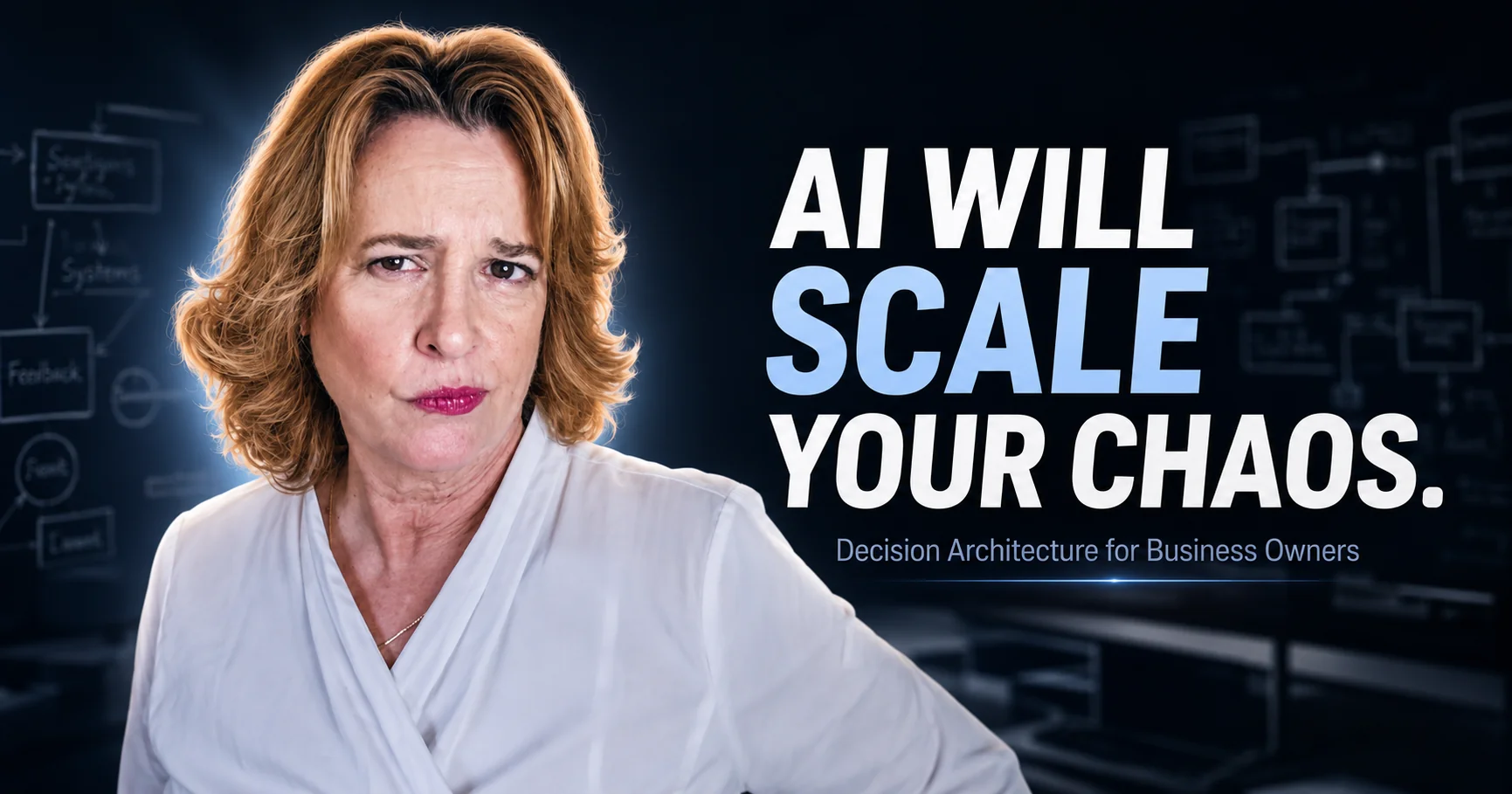
Most business owners believe their days are chaotic because they’re busy. The truth is harder to hear: the chaos is self-generated. It’s manufactured, one reactive decision at a time, by a business that was never built with a decision architecture in place.
Every interruption you respond to, every problem your team escalates to you, every “quick call” that rewrites the afternoon — these aren’t random. They are the predictable output of a structural gap. And until we name that gap clearly, we will keep mistaking busyness for leadership.
Not a reader? Watch the full breakdown here. ↑
The Real Problem Isn’t Your Schedule. It’s Your Decision Infrastructure.
Here’s what reactive decision-making actually looks like inside an established business:
A team member hits a situation they haven’t seen before. Instead of consulting a framework, policy, or precedent, they do the natural thing — they call the owner. The owner, mid-focus or mid-meeting, answers. A decision gets made. Problem solved, right?
Wrong.
Because here’s what just happened: the owner just reinforced that the correct path for every novel situation is to escalate. The team member learned nothing structural. No framework was created. No precedent was documented. And tomorrow, a slightly different version of the same situation will produce the same phone call.
This pattern, repeated dozens of times a day, is not a time management problem. It is a structural design failure. The business has no decision architecture — no consistent set of frameworks, criteria, or principles that allow the team to make good decisions without owner involvement.
And the cost is staggering. A 2025 analysis by BCG found that organizations consistently falling short of their operational targets underperform on shareholder return by an average of 9 percentage points compared to peers — and reactive, undisciplined decision-making is a primary driver of that gap.
But cost is only part of the story. The deeper damage is cultural. When the owner is the decision engine, the team stops developing judgment. They stop owning outcomes. They become skilled at executing tasks, not at leading results. The business that was meant to create freedom for the owner instead creates permanent dependency — in both directions.
Why Smart Owners Stay Stuck in Reactive Mode
This is the part most business content skips: reactive decision-making doesn’t feel like a failure. It feels like leadership.
When you’re the person everyone comes to, when your team trusts your judgment, when problems get solved because you’re in the room — that feels like being indispensable. And for most high-performing owners, indispensability is the identity they’ve built over years of proving themselves.
But indispensable isn’t scalable. And it certainly isn’t sellable.
The RAD principle of 100% Responsibility for Results applies here in an uncomfortable way. The owner who complains about being constantly interrupted is 100% responsible for the structure — or lack of structure — that makes interruption the only rational response available to the team. The team isn’t failing. The architecture is.
This is also where the RAD principle of Clarity Removes Stress becomes structural, not philosophical. The reason owners feel stressed isn’t that the business is too demanding. It’s that the business is operating without the clarity structures that would allow it to run without them. Every reactive decision is evidence of an unanswered structural question.
As management thinker Peter Drucker observed, “Efficiency is doing things right; effectiveness is doing the right things.”
Reactive decision-making maximizes efficiency at the task level while systematically destroying effectiveness at the leadership level. We stay busy solving the wrong problems.
The Three Structural Gaps Behind Reactive Decision-Making
When we diagnose this pattern in the RAD Business Success Method™, we consistently find three structural gaps driving it:
1. No Decision Criteria — The Team Doesn’t Know What “Good” Looks Like
In most owner-dependent businesses, decision criteria live in the owner’s head. They’ve never been articulated, documented, or taught. So the team can’t replicate the owner’s judgment — not because they lack capability, but because the standard has never been made explicit.
The fix isn’t training. It’s translation. The owner’s judgment needs to be reverse-engineered into criteria: What would make this decision correct? What factors matter? What would disqualify an option? Once those criteria exist in documented form, the team can make consistent decisions without the owner in the loop.
2. No Decision Rights Map — Nobody Knows Who Owns What
Reactive escalation thrives in ambiguity. When it’s unclear who has the authority to decide what, the safest move for any team member is to escalate. And so they do.
A Decision Rights Map — sometimes called a RACI, but more strategically structured — explicitly defines who can decide what, at what threshold, and when escalation is genuinely required. This isn’t bureaucracy. It’s precision. It removes the ambiguity that makes reactive escalation rational behavior.
3. No Documented Precedent — Every Decision Starts From Zero
Most businesses solve the same problems repeatedly. The owner gives essentially the same answer to essentially the same question — but because it’s never captured, the team has no reference point. Every situation feels novel because the institutional memory lives in one person’s head, not in an accessible system.
Documented precedent — a simple decision log, playbook, or operating procedure — transforms repeated judgment into replicable process. As we explore in How Structurally Mature Businesses Operate Differently, the companies that scale with stability are the ones that convert owner knowledge into organizational knowledge.
Why the AI Era Makes This an Urgent Business Priority
Here’s the inconvenient truth for any business owner planning to leverage AI: AI amplifies whatever decision infrastructure — or lack of infrastructure — already exists.
If your team operates with consistent decision frameworks, clear criteria, and documented precedent, AI can supercharge that consistency. It can apply your standards faster, at higher volume, with greater precision.
But if your business runs on reactive, ad hoc decision-making? AI scales that inconsistency. It generates confident-sounding outputs that reflect an unstable foundation. As CX Today recently reported, AI scales decisions — not just good ones: when the underlying logic is fragmented, automation makes “inconsistency the customer experience” at speed.
A 2025 paper cited by the Corporate Finance Institute found that organizations building strong decision processes before scaling AI use will compound those strengths over time — while those that don’t will find that AI amplifies their existing biases and blind spots.
We covered this dynamic in depth in AI Is Not Your CEO. The core insight applies here: AI is a leverage tool. If the lever is attached to a structurally sound foundation, it moves the business forward. If the lever is attached to chaos, it moves chaos faster.
The question isn’t whether your business is ready to use AI. The question is whether your business’s decision infrastructure is ready to have AI applied to it.
Three Structural Actions to Replace Reactive Decision-Making
These aren’t tips. They’re architectural interventions — the kind we design in the RAD Discovery and Design phases with established business owners ready to build real structural independence.
Action 1: Conduct a Decision Audit
For the next two weeks, log every decision that lands on your desk. Note the topic, the threshold, and whether the team could have made it with the right framework in place. Most owners discover that 60–80% of escalated decisions shouldn’t require them at all. The audit makes the structural gaps visible — and you can’t fix what you haven’t named. This is RADical Awareness in practice.
Action 2: Build Your Decision Framework Library — Starting with Your Top 10
Identify the ten categories of decisions that recur most frequently. For each one, document the criteria for a good decision, the threshold for escalation, and two or three real examples of how you’ve made this call in the past. This is not a policy manual — it’s a judgment codex. Give it to your team. Walk through it together. Test it against real scenarios.
Action 3: Assess Your AI Readiness Before You Scale
Before adding AI tools to any business process that involves decisions, assess whether the underlying decision infrastructure is solid enough to leverage AI without amplifying inconsistency. A structured diagnostic is the fastest path to that clarity — and it tells you exactly where to strengthen structure before you scale it. (More on that below.)
As we explored in The Hidden Cost of Being the Bottleneck, owner dependency has compounding costs — and decision dependency is among the most expensive forms.
The Business You’re Building Is Only as Reliable as Its Decisions
Reactive decision-making doesn’t just exhaust owners. It caps businesses.
A company that requires owner judgment for every novel situation cannot grow beyond the owner’s bandwidth. It cannot hire and retain high-caliber people who want authority and ownership. It cannot integrate AI with any confidence. And it cannot be sold, because the moment the owner exits, the decision engine exits with them.
Structure doesn’t constrain good decision-making. It enables it. The owners who build decision frameworks aren’t removing themselves from leadership — they’re elevating what leadership means in their business. They move from being the answer to every question to being the architect of a system that consistently produces great answers.
That is what structural independence looks like. And it starts with the clarity to see what you’re actually building.
Is your business ready to leverage AI — or would it just scale the chaos faster?
The AI Readiness Diagnostic™ is a free diagnostic tool that assesses whether your business’s decision infrastructure, systems, and operational structure are positioned to leverage AI — or whether AI adoption at this stage would amplify existing gaps.
It takes about 10 minutes. The results will tell you exactly where you stand.
→ Take the AI Readiness Diagnostic™ — Free
Frequently Asked Questions
What is reactive decision-making, and how does it differ from responsive leadership?
Reactive decision-making occurs when decisions are made in response to immediate pressure, urgency, or escalation — without consistent frameworks, criteria, or authority structures to guide them. Responsive leadership, by contrast, means a business has the structural clarity to move quickly and consistently, because decision frameworks are in place. The difference isn’t speed. It’s design.
Why do established business owners struggle with reactive decision-making even after years in business?
Because reactive decision-making is often mistaken for strong leadership. When the owner is the person everyone relies on for answers, it feels like being effective. The structural cost — to the team’s growth, to the business’s scalability, and to the owner’s bandwidth — only becomes visible when growth stalls or the owner tries to step back.
How does reactive decision-making affect team performance and retention?
Teams operating in reactive, owner-dependent environments gradually stop developing independent judgment. Over time, this leads to disengagement, reduced ownership of results, and higher turnover — particularly among high performers who want decision authority and accountability in their roles.
What is a Decision Rights Map, and does a business our size really need one?
A Decision Rights Map defines who has the authority to make which decisions, at what threshold, and when escalation is appropriate. For any business with more than 3–5 employees, this structure is essential — not as bureaucracy, but as clarity. It removes the ambiguity that makes escalation the default behavior.
How does reactive decision-making affect a business’s ability to use AI effectively?
AI amplifies whatever decision infrastructure exists in the business. If decision-making is inconsistent, ad hoc, or undocumented, AI systems trained on or guided by that infrastructure will scale the inconsistency — faster and at higher volume than humans ever could. Structural clarity is a prerequisite for responsible AI leverage.
What’s the first step for an owner who recognizes this pattern in their business?
Start with a Decision Audit: log every decision that reaches you over a two-week period, and identify which ones shouldn’t require your involvement if the right frameworks existed. Most owners discover that a significant majority of escalations are structurally preventable. That audit is the foundation for building a real decision architecture.
How does the RAD Business Success Method™ address decision-making structure?
The RAD methodology addresses decision structure primarily in the RADical Discovery phase (diagnosing where structural gaps exist) and the RADical Design phase (installing the decision frameworks, rights maps, and documented precedent that allow the business to operate independently). You can explore the full methodology at radstrategic.com/business-operating-methodology.
What is the AI Readiness Diagnostic™ and who is it for?
The AI Readiness Diagnostic™ is a free tool for established business owners who want to understand whether their business’s structure, systems, and decision frameworks are ready to leverage AI effectively — or whether AI adoption at this stage would create more risk than advantage. It’s designed for owners of businesses generating $500K–$10M+ in revenue who are actively exploring AI integration.
How long does it take to build a decision framework library?
For a focused owner, identifying and documenting the top 10 recurring decision categories can be accomplished in two to three focused working sessions. The ROI is immediate: teams begin making better decisions with less escalation within weeks of implementation.
Angie Dobransky is the founder of RAD Strategic Partners and creator of the RAD Business Success Method™ — a six-phase operating methodology that transforms owner-dependent businesses into structured, scalable, self-sustaining companies. Her book, 52 Steps to RADical Success, is available now.