Leadership and Mindset | AI and Productivity | Business Strategy and Growth | Systems and Operations
Leadership Is Modeled Through Structure, Not Words — And AI Is Proving It
June 8, 2026May 20, 2026 Leadership and Mindset, AI and Productivity, Business Strategy and Growth, Systems and Operations
There is a version of leadership that sounds impressive in meetings, reads beautifully in company values documents, and gets applauded at the all-hands. And then there is the version of leadership that actually runs the business — the one your team experiences at 9 a.m. on a Tuesday when a decision needs to be made and you’re not in the room.
Those two versions are often very different. And the gap between them? That’s not a communication problem. That’s a structural problem.
Most established business owners I work with are strong communicators. They articulate expectations clearly. They talk about accountability, ownership, responsiveness, quality. They mean it. And then they wonder why the business still routes every decision through them, why standards drift when they’re traveling, why the team “doesn’t take initiative.”
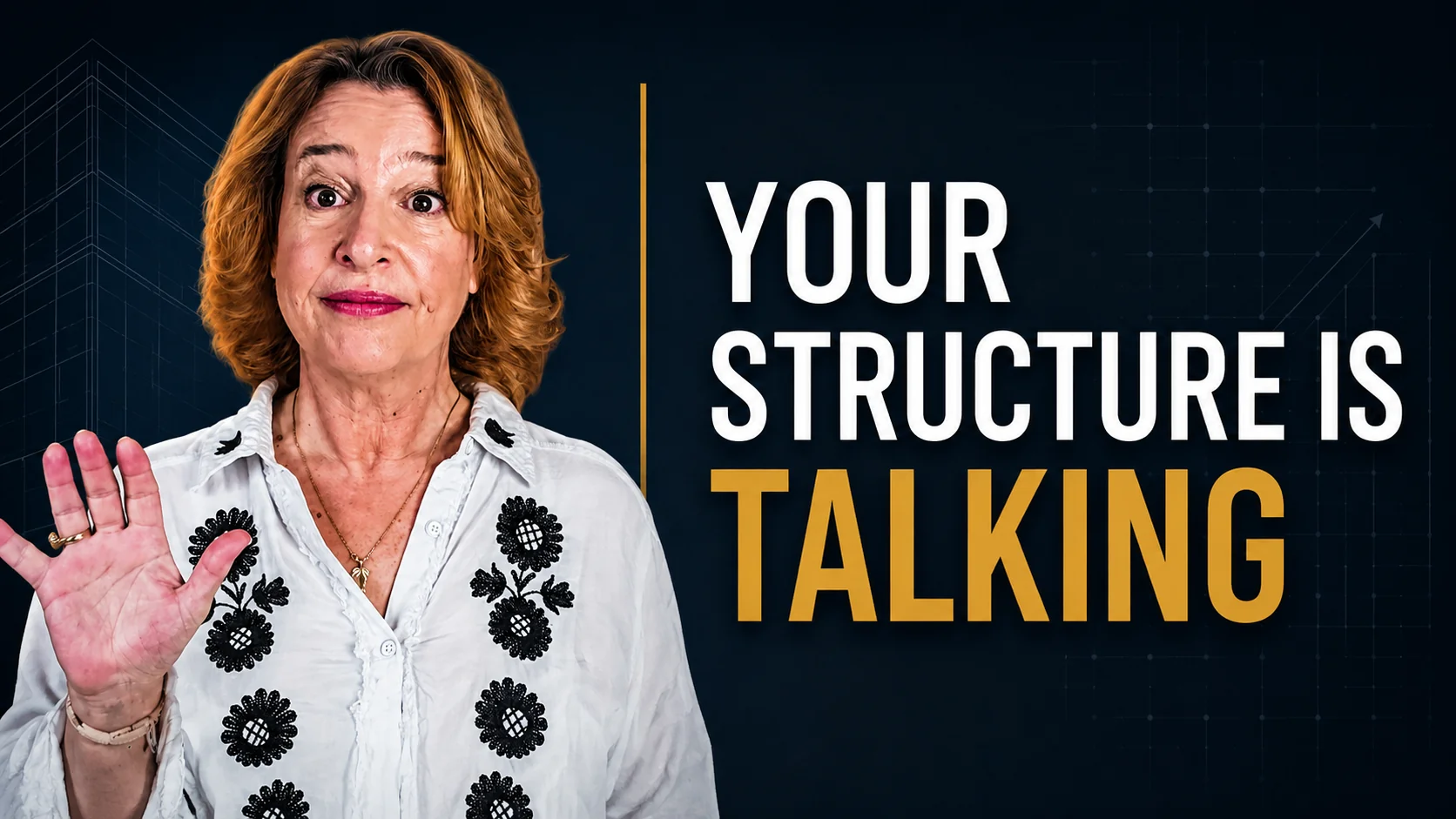
Here’s the uncomfortable truth: Your words communicate what you want. Your structure communicates what you’ll actually accept.
If those two things don’t match — and in most businesses they don’t — your team is taking their cues from the structure, not the speech. Every time. Without exception.
Not a reader? Watch the full breakdown here. ↑
The Leadership Expectation Gap — And Why It Persists
The gap between stated expectations and operational reality is one of the most consistently underestimated problems in established businesses. A 2024 Right Management study found that 83% of leaders say their employees are highly engaged — but only 48% of employees agree. That’s not a morale problem. That’s a structural signal that leaders and teams are experiencing fundamentally different realities inside the same organization.
Quantum Workplace’s 2025 Workplace Trends Report adds a sharper point: only 19% of employees strongly agree their manager explains how company values actually connect to their day-to-day work. Not because the values are unclear — but because the structures that would reinforce them don’t exist.
Think about that. You’ve articulated the vision. You’ve defined the values. You’ve communicated the expectations. And still, most of your team can’t connect those expectations to the work in front of them. Not because they weren’t listening. Because the structure didn’t back it up.
This is what we mean when we say leadership is modeled, not announced. It’s one of the core operating principles inside the RAD Business Success Method™ — and it is perhaps the principle business owners most consistently underestimate the cost of getting wrong.
“The standard you walk past is the standard you accept.” — General David Morrison, Australian Army Chief of Staff
That quote doesn’t require an army. It applies in every business where leaders tolerate behavior or performance that contradicts the expectations they’ve stated. And in most businesses, it happens constantly — not out of laziness or bad intent, but because the structure to reinforce the standard simply isn’t there.
What “Structural Leadership” Actually Means
Let’s get specific, because this concept gets abstract fast.
When we say leadership is modeled through structure, we mean that your real expectations — the ones that govern actual behavior — live in your systems, your policies, your decision frameworks, your onboarding, your meeting rhythms, and your accountability architecture.
Not your words. Not your culture deck. Not your Slack announcements.
Here’s what this looks like in practice:
You say: “We are a team that operates with urgency and ownership.” Your structure says: There are no defined response time standards. Escalations still go to you. No one has clear decision authority over anything. Every project waits for your review.
You say: “We hold each other accountable.” Your structure says: There are no documented performance standards. Feedback is informal and sporadic. Accountability conversations only happen when something breaks.
You say: “We are client-focused above all else.” Your structure says: Client onboarding is inconsistent. Service delivery depends on which team member handles it. There’s no documented standard for what “excellent” looks like.
In each of these cases, the words are right. The values are genuine. But the structure has made a different decision — and the team is following the structure.
This is not a leadership character flaw. It’s a leadership design gap. And as we explore inside the RAD Business Success Method™, structural problems require structural solutions. Not more communication. Structure.
Three Structural Gaps That Undermine Leadership Credibility
1. The Expectation Without a Framework
Most leaders state expectations without building the framework that gives those expectations operational teeth.
“Be proactive” is a value. A decision authority matrix is a structure. The value is invisible to the team when there’s no operational mechanism that rewards, enables, or requires it.
When we work with established business owners, one of the first diagnostic exercises we do is map the gap between stated expectations and existing frameworks. As explored in The Hidden Cost of Being the Bottleneck, most owners discover that 70–90% of decision authority still routes through them — not because their team is incapable, but because no decision architecture exists to enable anything else.
The expectation of ownership without the structure of delegation is a contradiction. And contradictions create confusion. Confusion creates dependency. Dependency creates the bottleneck.
The fix is structural: build decision frameworks that define who owns what, at what threshold, with what criteria. Then your expectation of “ownership” finally has a structural backbone.
2. The Standard Without Reinforcement Infrastructure
Standards only hold when there is infrastructure to reinforce them.
If your standard is “consistent, excellent client experience” but your team has no documented service framework, no quality checkpoints, and no measurement mechanism — you don’t have a standard. You have a preference. And preferences bend to capacity, mood, and individual interpretation.
This is where SOPs become a leadership statement, not just an operational tool. A documented process is how a leader communicates: “This is what we expect. Every time. Regardless of who is doing it.”
Without that documentation, every team member invents their own version of the standard — which means there is no standard. Only a stated preference and a recurring disappointment.
3. The Value Articulated Without Behavioral Anchors
Values without behavioral anchors are decoration.
“We value integrity.” “We value innovation.” “We value teamwork.” These statements mean nothing unless they are tied to specific, observable, structural behaviors — behaviors that are acknowledged, measured, and reinforced in the operating rhythms of the business.
What does “integrity” look like in a vendor negotiation? What does “innovation” look like in a team meeting? What does “accountability” look like in a performance review conversation? If those behaviors aren’t defined and structurally reinforced, the value exists only in the language — not in the culture.
Leaders who want their values to live in the organization must install the structural anchors that make them operational. That’s not soft work. That’s the architecture of culture — and it is as deliberate as building a financial reporting system. As we note in Why Most Business Owners Struggle to Explain Their Value, if your team can’t demonstrate your standards without you present, your leadership is personality-dependent — not structurally mature.
The AI Factor: When Your Structure Gets a Mirror
Here is where this conversation becomes urgent in a way it wasn’t three years ago.
AI doesn’t just accelerate operations. It exposes them.
When you deploy AI tools across a team operating without clear decision frameworks, documented standards, and defined expectations, what happens? The AI amplifies the inconsistency. Every team member uses the tools differently. Outputs diverge. Quality becomes even more variable. And the gap between stated expectations and operational reality gets wider — faster.
McKinsey’s 2025 State of AI research is clear: workflow redesign — not tools — has the biggest effect on an organization’s ability to see measurable business outcomes from AI. The biggest barrier to AI success isn’t technology. It’s leadership structure.
The leaders who will win in this era are not the ones who adopt AI fastest. They’re the ones who have built the structural clarity that lets AI serve as a force multiplier rather than a confusion amplifier.
As we wrote in The Hard Truth About Growth — And Why AI Is Calling It Out: when systems are clean, AI accelerates growth. When systems are messy, AI amplifies the mess.
Your leadership structure is either ready for that mirror — or it isn’t. There is no in-between.
Building a Leadership Structure That Actually Models Your Expectations
This is the work. Not the inspiration — the architecture.
Here is a practical starting framework drawn from the RAD Business Success Method™:
Step 1: Audit the Gap List your top five stated expectations or values. For each one, identify the structural mechanism that currently reinforces it. If you can’t name the mechanism, the structure doesn’t exist. The gap is your diagnosis.
Step 2: Build Decision Architecture Define decision authority clearly — who owns what, at what dollar/risk threshold, with what criteria. When teams have clear decision authority, they stop defaulting upward. This is how you model “ownership” structurally rather than just verbally.
Step 3: Document the Standard For every key area of the business, document what “excellent” looks like. Not as an inspiration statement — as a specific, observable, measurable standard. This is how your expectations survive your absence.
Step 4: Install Accountability Rhythms Accountability doesn’t happen in annual reviews. It happens in the weekly operating rhythms — the check-ins, the reporting, the meeting structures. Build the rhythm that makes accountability structural rather than reactive.
Step 5: Measure What You Model You measure what matters. If you say accountability matters but don’t measure it, the team hears the real priority. Align your measurement systems to your stated expectations — and the structural signal becomes consistent.
This is what it means to evolve your leadership from announced to modeled. Not more conviction. More architecture. As explored in Delegate, Don’t Abdicate — strong leaders don’t disappear when they delegate. They design clarity. That’s the shift.
The Leadership Maturity Question
Here is the question that matters:
If you stepped out of your business for 30 days, would the standards hold — or would they slowly drift back to whatever each individual team member decides is “good enough”?
If the honest answer is “they’d drift” — that’s not a team problem. That’s a structural leadership problem. The expectations aren’t modeled. They’re just stated.
Leadership maturity, inside the RAD Business Success Method™, is measured not by what you say or even what you believe — but by what your structure consistently produces when you are not in the room.
The most structurally mature businesses we work with share a common trait: their leaders have built systems, frameworks, and accountability architectures that carry the leadership expectations forward, independent of the owner’s direct involvement. That independence — that structural reliability — is the definition of a scalable company. And it is built, deliberately, one structural decision at a time.
The businesses that thrive in this next decade will not be the ones with the most inspirational leaders. They will be the ones whose leaders had the discipline to build a business that doesn’t require their constant presence to perform at the standard they demand. That’s not abdication. That’s architecture. That’s RADical leadership.
Ready to close the gap between what you say and how your business actually runs?
Start with the Structural Independence Assessment™ — a diagnostic tool that evaluates exactly how structurally dependent your business is on you as the owner, and where the real gaps live. Or if you’re ready to go deeper, book a strategic coaching call and let’s build the leadership architecture your business has been missing.
Frequently Asked Questions
What does it mean that “leadership is modeled, not announced”?
It means that what your team follows is not what you say — it’s what the structure of your business consistently reinforces. If your stated expectations are not backed by decision frameworks, documented standards, and accountability systems, your team will default to whatever the structure does support, regardless of what you’ve communicated verbally.
Why do verbal expectations fail even when leaders communicate clearly?
Because behavior is governed by structure, not speeches. Teams respond to what is measured, what is rewarded, what is documented, and what actually happens when a decision needs to be made. If those structural signals contradict the verbal expectation, the structure wins every time.
What is leadership structure and how is it different from leadership style?
Leadership style is how you communicate and interact. Leadership structure is the architecture you build: decision authority frameworks, documented standards, operating rhythms, accountability systems. Style is personal. Structure is operational — and it’s structure that scales.
How does AI expose the gap between stated and structural leadership?
When AI is deployed across a business with weak structural clarity, it amplifies inconsistency. Team members use AI tools differently, outputs diverge, and the gap between stated expectations and operational reality widens. AI rewards structural maturity and exposes its absence.
What is the “expectation gap” and why does it matter?
The expectation gap is the distance between what a leader states they expect and what the business operationally produces. Research shows that most leaders significantly overestimate alignment — with gaps large enough to affect performance, retention, and culture. Closing this gap requires structural work, not more communication.
How do I know if my business has a leadership structure problem?
Key signals: decisions still route through you even on issues you’ve “delegated,” standards drift when you’re absent, results are inconsistent across team members, and new hires take a long time to understand what “good” looks like. These are structural symptoms, not personnel problems.
What is decision architecture and why does every business owner need it?
Decision architecture is a documented framework that defines who owns what decisions, at what level of authority, with what criteria. Without it, your team defaults upward — creating bottlenecks, slowing execution, and stifling ownership. It’s one of the foundational structural elements of a scalable business.
How does the RAD Business Success Method™ address leadership structure?
The method addresses it directly in the RADical Design phase — where decision frameworks, operating rhythms, communication standards, and accountability architecture are installed. It also reinforces it through the 8th Operating Principle: Leadership Is Modeled, Not Announced.
Can a business scale without structural leadership clarity?
It can grow — temporarily. But growth without structural leadership clarity creates compounding chaos: more people, more inconsistency, more owner involvement, more bottlenecks. Scaling requires that leadership expectations be embedded in the design of the business, not dependent on the owner’s constant presence.
What’s the first step for a business owner who wants to build more structural leadership clarity?
Start with an honest gap audit: identify your top stated expectations and find the structural mechanism that currently reinforces each one. Where there is no mechanism, there is a structural gap — and that gap is your starting point. The Structural Independence Assessment™ is a useful tool for this diagnosis.
#AI leadership gap#business owner leadership#business structure systems#decision framework business#leadership accountability#leadership clarity#leadership expectations gap#leadership is modeled not announced#leadership maturity#leadership structure#modeling leadership#owner-dependent business#RAD business method#scalable leadership#structural leadership
Previous
What a Real Business System Actually Looks Like (It’s Not What You Think)
Next
Your Business Doesn’t Have a Chaos Problem. It Has a Decision Architecture Problem.