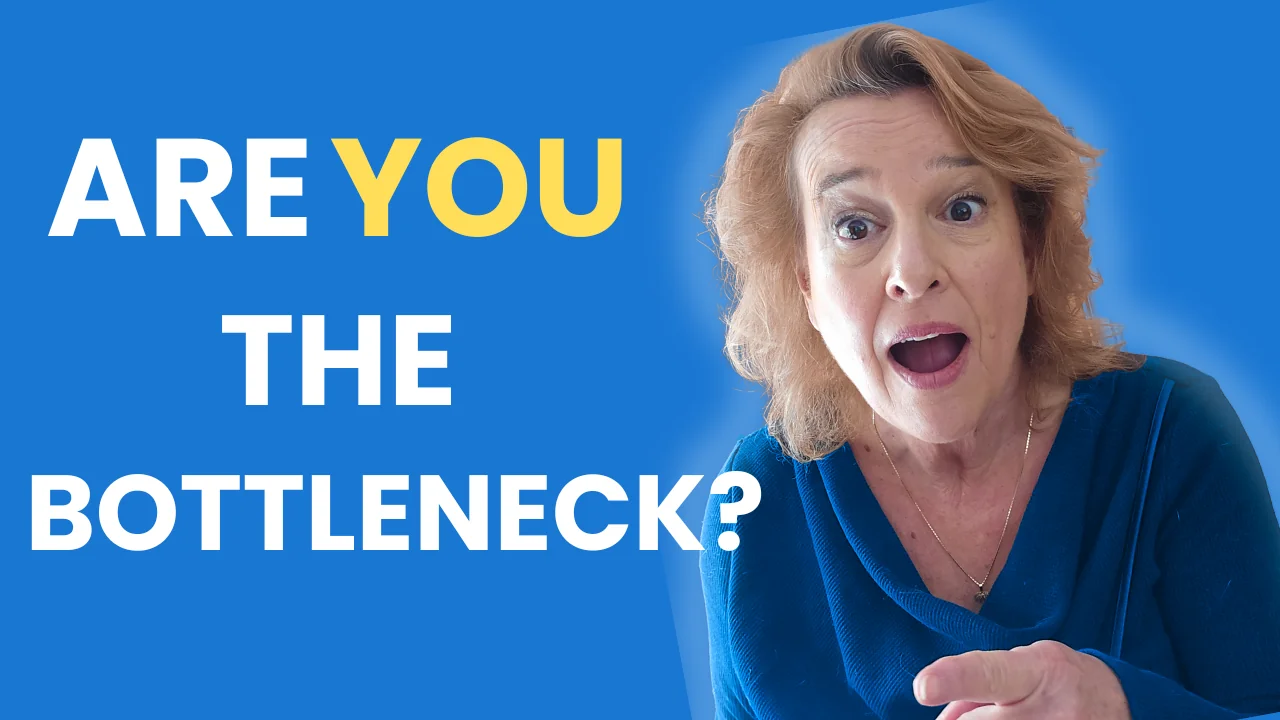
The Hidden Cost of Being the Bottleneck
If your business slows down when you step away, you don’t own a company.
You own a job.
And not just any job — the highest-stress, highest-responsibility job in the organization. And that is the biggest cost of being the bottleneck.
Most established business owners I work with are not lazy. They’re not disorganized. They’re not incapable.
They’re indispensable.
And that’s the problem.
The Owner Bottleneck Is Not a Workload Problem
When an owner feels overwhelmed, the instinct is to solve it tactically:
Hire another person
Add software
Work longer
Try better time management
But overwhelm at your level is rarely about time.
It’s about
structural dependency
(how structurally mature businesses operate differently)If approvals, pricing decisions, hiring calls, vendor choices, customer escalations, and strategic direction all flow through you, then growth is capped at your personal processing capacity.
That’s not a productivity issue.
That’s an operating system issue.
And it’s expensive.
Watch the Full Breakdown
If your business slows down when you step away, you are not leading a scalable company — you’re operating as the central processor.
In this video, I walk through exactly how owner dependency forms, how it suppresses growth, and how to redesign your operating structure so the business can run without constant oversight.
The Hidden Costs No One Talks About
Most owners recognize they’re busy. What they don’t fully quantify is what it’s costing them.
1. Revenue Compression
When deals stall because “we’re waiting on the owner,” speed drops. And speed is a growth multiplier.
Slow decisions reduce:
Close rates
Customer experience
Competitive positioning
The market rewards responsiveness. If your business must route through you, you are throttling your own revenue.
2. Talent Suppression
High-performing team members want responsibility.
If they are constantly escalating decisions upward, they either:
Stop thinking critically
Or leave
Owner dependency quietly drives talent churn.
3. Strategic Drift
When you’re buried in tactical approvals, you lose altitude.
The business may still be operating… but it isn’t being led.
And leadership vacuum at the top shows up later as:
Margin erosion
Cultural confusion
Reactive decision-making
4. Valuation Risk
If you ever plan to sell, transition, or even take extended time off, dependency lowers enterprise value.
Investors and buyers ask one question:
“What happens if the owner steps out?”
If the answer is “Everything stops,” the valuation drops accordingly.
Owner dependency directly reduces business value and buyer confidence.Why Owners Become the Bottleneck (Even Smart Ones)
Let’s be honest.
This doesn’t happen because you’re incompetent.
It happens because you’re capable.
In early growth phases, founder intensity drives momentum. You move fast. You decide quickly. You fix problems.
But what built the business is not what scales the business.
At $500K, hero leadership works.
At $5M, it breaks.
This is where operational maturity must replace hustle.
Research on delegation and business performance.The Leadership Shift at Scale
As management thinker
Peter Drucker
famously said:
“The best way to predict the future is to create it.”
At early stages of business, we create the future through effort.
At scale, we create the future through design.
That’s the shift.
You don’t build a scalable company by reacting faster.
You build it by engineering how decisions get made.
The RADical Reframe
“The business does not grow beyond the clarity of its decision architecture.”
Owner dependency is not a personality flaw.
It is a missing system.
Within the RADical Success framework, we shift from:
Owner-as-doer
Owner-as-designer
Your role evolves from executing decisions to
engineering decision pathways.
That is a structural shift.
The Structural Diagnosis: Where Are You the Gate?
Here are common owner choke points:
Final pricing authority
Hiring approvals
Client escalation decisions
Vendor selection
Marketing messaging sign-off
Strategic prioritization
Financial oversight
Technology adoption
If your team constantly asks:
“Can you just take a quick look at this?”
You are likely the decision bottleneck.
How to Build a Business That Runs Without You
This is not about disappearing.
It’s about redesigning.
Here is the practical framework I use with established business owners:
Step 1: Map Decision Categories
List the recurring decisions made in your business:
Operational
Financial
Client-facing
Strategic
Technical
Now identify:
Which are currently centralized with you
Which are partially delegated
Which are fully owned by others
Most owners discover 70–90% of decision authority still routes through them.
Step 2: Create Decision Lanes
For each category, define:
Who owns the decision
What budget authority exists
What criteria must be met
When escalation is required
Without clarity, teams default upward.
Clarity creates autonomy.
Step 3: Install Escalation Frameworks (Not Constant Oversight)
Instead of approving everything, design triggers:
Escalate only if margin impact exceeds X%
Escalate only if client risk exceeds Y threshold
Escalate only if cost exceeds Z dollars
Now you’re no longer reviewing everything.
You’re reviewing exceptions.
That’s operational maturity.
Step 4: Use AI to Reduce Friction (Not Replace Judgment)
AI is not here to remove leadership.
(why AI is not a substitute for leadership judgment)It is here to remove processing drag.
Smart owners are using AI to:
Draft SOPs
Analyze recurring issues
Create pricing models
Improve internal communication
Build knowledge libraries
Reduce repetitive approval cycles
When information becomes clearer and faster, teams make better decisions without escalating everything.
AI reduces bottlenecks by increasing structured clarity and
AI reduces operational bottlenecks when structure already existsStep 5: Elevate Your Role
Once decisions decentralize, your role shifts to:
Strategy
Culture
Capital allocation
Market positioning
AI-era redesign
This is the transition from operator to operating architect.
Signs You’re Making Progress
You’ll know the redesign is working when:
Fewer Slack/Teams messages require your input
Revenue doesn’t stall when you’re unavailable
Managers resolve conflicts independently
You spend more time on growth than approvals
The business runs smoothly during your absence
That’s structural freedom.
The Strategic Truth
Owner dependency feels responsible.
But at scale, it’s reckless.
The cost is not your stress.
The cost is suppressed growth.
If you’re serious about building a business that runs without you — not because you want to disappear, but because you want leverage — you must diagnose where you’re the gate.
Clear Action Plan
Block 90 minutes this week.
Map your top 20 recurring decisions.
Identify which ones only you can truly own.
Define escalation criteria for the rest.
Begin transferring structured authority.
If you want a guided process, start with the Owner Dependency Diagnostic™.
Because clarity precedes freedom.
Take the
Structural Independence Assessment™to diagnose where you’re the gate
FAQ — AI + SEO Optimized
1. What is owner dependency in a business?
Owner dependency occurs when key decisions, approvals, and operations rely primarily on the business owner, limiting scalability and growth.
2. How do I know if I am the bottleneck in my company?
If decisions consistently require your approval, progress slows when you are unavailable, or your team escalates routine matters upward, you are likely the bottleneck.
3. Why does owner dependency reduce business growth?
It limits decision speed, suppresses team autonomy, increases operational friction, and restricts strategic focus.
4. Can AI help reduce business bottlenecks?
Yes. AI can streamline information processing, document workflows, support decision modeling, and reduce repetitive approval cycles.
5. How can I delegate without losing control?
By defining decision criteria, budget thresholds, and escalation triggers rather than delegating blindly.
6. Does reducing owner dependency increase company valuation?
Yes. Businesses that operate independently of the owner are more attractive to investors and buyers.
7. What is the first step to building a business that runs without me?
Map recurring decisions and identify where authority can be structured and decentralized.