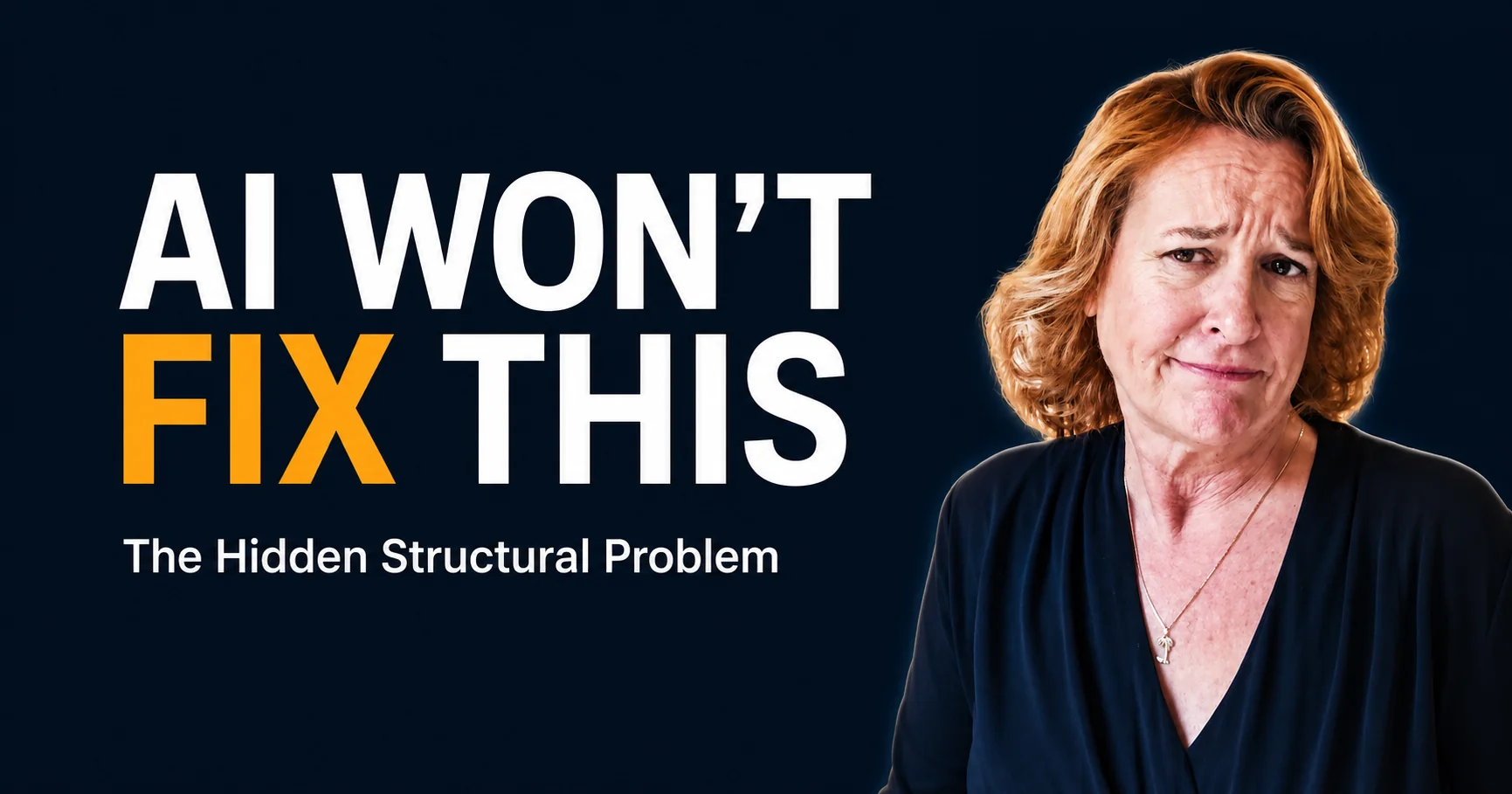
Here’s a contrarian truth most AI consultants won’t tell you: AI is not your competitive advantage. Your decision system is.
AI just makes that decision system visible — at scale, in public, with receipts.
For 18 years, I’ve watched established business owners build remarkable companies on instinct, experience, and the sheer force of their own judgment. And it worked. Until it didn’t. Now AI is racing into every corner of the business — generating proposals, screening candidates, drafting offers, prioritizing leads, recommending pricing changes — and the leaders who never formalized how decisions actually get made are discovering something uncomfortable: AI doesn’t just speed up good decisions. It industrializes bad ones.
This is the structural blind spot of the AI era. And it’s the one almost no one is talking about.
Not a reader? Watch the full breakdown here. ↑
The Hidden Structural Problem AI Just Exposed
When a business runs on the owner’s judgment, decisions feel fast. The owner sees the situation, weighs the variables in their head, and calls it. To everyone watching, it looks like decisiveness. To the owner, it feels like leadership.
But here’s what’s actually happening: the system for making that decision lives inside one person’s head. There’s no documented logic. No criteria. No tradeoff framework. No escalation path. Just a pattern the owner has refined over years — and never written down.
That worked when the business was smaller. It worked when the owner was personally involved in every meaningful choice. It even worked when growth was linear.
Then AI showed up. And suddenly, instead of one person making 40 decisions a day with their experience-trained intuition, your team is using AI to make 400 decisions a day — drawing from prompts written by people who don’t carry the owner’s judgment in their heads.
The result is not faster decisions. It is amplified inconsistency.
Recent McKinsey research underscores how widespread this problem is. According to McKinsey’s research, 88% of organizations use AI in at least one function, but only 39% see any impact on EBIT — most often less than 5%. A 2025 MIT NANDA study put a sharper point on it: 95% of enterprise generative AI pilots deliver no measurable profit-and-loss impact — not because the models were bad, but because the organizations were not ready to use them at scale. Duperrin Boston University
That’s not a technology problem. That’s a structural problem. And it’s hiding inside almost every owner-led business right now.
What “Weak Decision System” Actually Looks Like
Most owners don’t know they have a weak decision system because they’ve never had a reason to look at it directly. So let me show you what it looks like in practice. You’ll recognize at least three of these:
- Pricing decisions get made situationally — sometimes based on the deal, sometimes the client, sometimes the owner’s mood that week.
- Hiring decisions vary by who’s interviewing — and no one can articulate exactly what “the right fit” means in writing.
- Marketing approvals happen ad hoc — copy, offers, and campaigns get signed off based on instinct rather than criteria.
- Operational tradeoffs get resolved in hallway conversations — not in any documented framework.
- The team checks with the owner before doing anything that matters — because no one is sure where the lines actually are.
None of this looks broken. In fact, it usually looks like a tight, responsive, owner-led culture.
Until you layer AI on top of it.
Because the moment you give your team an AI tool, you’ve handed them a force multiplier. Whatever decision logic they’re already using — clear or unclear, documented or assumed, consistent or inconsistent — is about to get applied 10x more often, 10x faster, and across 10x more touchpoints.
If the underlying logic is weak, AI doesn’t fix it. AI scales it.
The RAD Reframe: Decisions Are Structural Architecture
This is where the RAD Business Success Method™ reframes the problem.
Most owners think of decision-making as a leadership skill. Something the owner is naturally good at, or trying to get better at. Something the team will “grow into” over time.
That framing is the problem.
Decision-making is not a skill. It is an operating layer of the business. It is structural architecture. It is one of the systems that makes a business scalable — or keeps it owner-dependent forever.
A structurally mature business has answers to questions like:
- Who is authorized to make which decisions, at what dollar threshold, with what inputs?
- What criteria does each major recurring decision use?
- What is the escalation path when a decision falls outside normal parameters?
- Where is this written down, taught, and reinforced?
An owner-dependent business has none of those answers documented. They live in the owner’s head. And that is exactly why everything escalates back to the owner — and why AI, when introduced into that environment, doesn’t relieve the bottleneck. It makes the inconsistency invisible until it’s expensive.
If you want a deeper look at how owner-dependence becomes a structural ceiling, we’ve broken that down in detail here.
What AI Actually Changes (And What It Doesn’t)
Here’s the part that makes my clients lean forward in their chairs.
AI is not the threat. AI is the opportunity of a lifetime for owners who have been carrying the business in their heads for years. For the first time, you have a tool that can take the genius locked inside your judgment and turn it into structured, repeatable, teachable systems. Not someday. Now.
But the sequence matters.
What AI changes:
- The cost of documentation collapses. Capturing how you actually think about a decision is now a 30-minute conversation, not a six-month consulting engagement.
- The speed of distribution accelerates. Your decision logic, once captured, can be embedded into prompts, workflows, and team training in days.
- The visibility of inconsistency increases. When AI applies a flawed framework 500 times, the pattern shows up in the numbers fast.
What AI doesn’t change:
- It does not invent judgment. It cannot generate a decision framework you’ve never articulated.
- It does not enforce discipline. A documented framework that nobody uses is still a useless framework.
- It does not replace structural leadership. Someone still has to design the architecture.
As we’ve written before, AI can generate a flawless business plan for a business that will never make money. The same principle applies to decisions. AI can produce flawless output from a flawed framework — and that is precisely the danger.
This is why organizations reporting significant financial returns from AI are twice as likely to redesign workflows before selecting AI tools. The winners are not the ones with the best AI. They are the ones with the clearest underlying structure for AI to amplify. Talyx AI
Three Structural Moves to Make Right Now
This is not a tip list. These are structural moves that change what your business is capable of in the AI era.
1. Audit Your Top 10 Recurring Decisions
Sit down and write out the ten decisions your business makes most often. Pricing exceptions. Hiring approvals. Vendor selections. Project scoping. Discount authorizations. Client offboarding. Whatever shows up weekly or monthly.
For each one, answer three questions:
What criteria are we actually using?
Where is that written down?
Who is authorized to make this without checking with me?
If you cannot answer those three questions for any of your top ten, that decision is a structural risk — and it will become a much bigger risk the moment AI gets involved.
2. Capture the Logic Before You Automate
This is the move my clients get most excited about, and rightly so. AI gives you the ability to externalize your judgment in a way that has never been possible before. But only if you do it in the right order.
The wrong order: deploy AI tools, watch the team use them inconsistently, scramble to add guardrails later.
The right order: document the decision framework first, then embed that framework into your AI workflows. The framework becomes the spine. AI becomes the speed.
This is exactly the kind of structural work we walk owners through inside the RAD Business Success Method™ — moving the business from owner-dependent judgment to documented, distributed decision architecture.
3. Install a Decision Review Rhythm
A decision framework that nobody revisits will rot. Build a quarterly review into your operating rhythm — pull the framework out, look at the decisions that got made under it, identify where it broke down or needed an override, and refine it.
This is the difference between a static document and a living operating system. And it’s the difference between AI accelerating your business and AI amplifying your blind spots.
For owners who want a broader leadership lens on this, our breakdown of analytical skills for the AI era walks through the thinking infrastructure that supports strong decision systems.
The Window Is Closing Faster Than You Think
Here is the structural reality every established business owner needs to internalize.
The owners who get this right in the next 12 months will not just outperform their competitors. They will re-engineer what their businesses are capable of producing — because they will have spent years carrying the company in their heads, and they will finally have a way to get it out.
The owners who don’t will discover, slowly and then suddenly, that their team is making decisions at AI speed using frameworks they were never taught — and the cost of that inconsistency will show up in margins, in client retention, in team turnover, and in the quiet creeping sense that the business is harder to control than it used to be.
This is not a tech problem. It is a structure problem. And structure problems have structural solutions.
That is exactly the work we do.
Ready to See Where Your Decision Architecture Stands?
Before you scale AI across your business, you need to know exactly where your structure is ready — and where it’s exposed. The AI Readiness Diagnostic™ is a 10-minute self-assessment that surfaces the structural gaps AI will amplify, and shows you exactly where to start.
Take the AI Readiness Diagnostic™ — and find out what AI will reveal about your business before your competitors do.
Frequently Asked Questions
What does it mean to have a “weak decision system” in a business?
A weak decision system is one where the logic, criteria, and authority for recurring decisions lives in the owner’s head rather than in documented frameworks. It looks fast and responsive in a small business, but it creates inconsistency, bottlenecks, and risk as the company grows — and AI dramatically accelerates that risk.
Why does AI expose weak decision systems instead of fixing them?
AI scales whatever logic it’s given. If the underlying decision framework is unclear, AI applies that unclear logic across hundreds of touchpoints. The result is amplified inconsistency, visible at scale — not better decisions.
Isn’t AI supposed to make decision-making easier for business owners?
Yes — but only when the business has documented decision frameworks for AI to execute against. AI is a force multiplier, not a strategist. It accelerates good structure and accelerates bad structure equally.
How do I know if my business has a structural decision problem?
If your team checks with you before making routine decisions, if pricing or hiring varies based on who’s involved, or if you can’t point to written criteria for your top recurring decisions — you have a structural decision problem. Most established businesses do.
Where should I start fixing this?
Start with the audit of your top ten recurring decisions. Identify which ones lack documented criteria, written authority levels, and clear escalation paths. That list becomes your structural roadmap.
What’s the difference between a decision framework and just having policies?
Policies tell people what to do. A decision framework tells people how to think — what criteria to weigh, what tradeoffs to consider, and when to escalate. AI can execute a framework. It cannot execute vague policies.
Does this only apply to large businesses?
No. This is most urgent for businesses in the $550K–$10M revenue range, because they’re large enough to feel the cost of inconsistency but small enough that the owner is still personally absorbing it. That’s exactly the structural window AI is reshaping.
How does this connect to the RAD Business Success Method™?
Decision architecture is part of the RADical Design phase — installing the structural systems that allow a business to operate independently of the owner. It’s foundational to making a business scalable and AI-ready.
Can I just buy an AI tool to solve this?
No. AI tools execute frameworks; they do not create them. Buying AI without first installing decision structure is exactly how organizations end up in “pilot purgatory,” running experiments that never graduate to production. Libertify
What’s the fastest way to get started?
Take the AI Readiness Diagnostic™ to see where your structural gaps are. Then start documenting your top three recurring decisions this week. Small structural moves compound fast.