Leverage Your Strengths for Leadership and Business Success
Discover how to leverage your unique strengths to boost leadership and business success. Learn 3 actionable steps to focus on your strengths and avoid burnout.
July 6, 2026
June 9, 2026
There is a story business owners tell themselves when things start feeling hard:
“If we just land a few more clients, we’ll have the resources to fix this.”
It is one of the most expensive stories in business.
Revenue growth does not solve operational problems. It accelerates them. The chaos you are managing at $1M becomes catastrophic at $3M. The bottleneck that slows your team today becomes a full systems failure tomorrow. And in the AI era, that timeline is collapsing — because AI doesn’t just grow your business faster, it surfaces your structural weaknesses faster.
The business owner who layers AI tools onto a structurally weak operation is not innovating. They are investing in a faster breakdown.
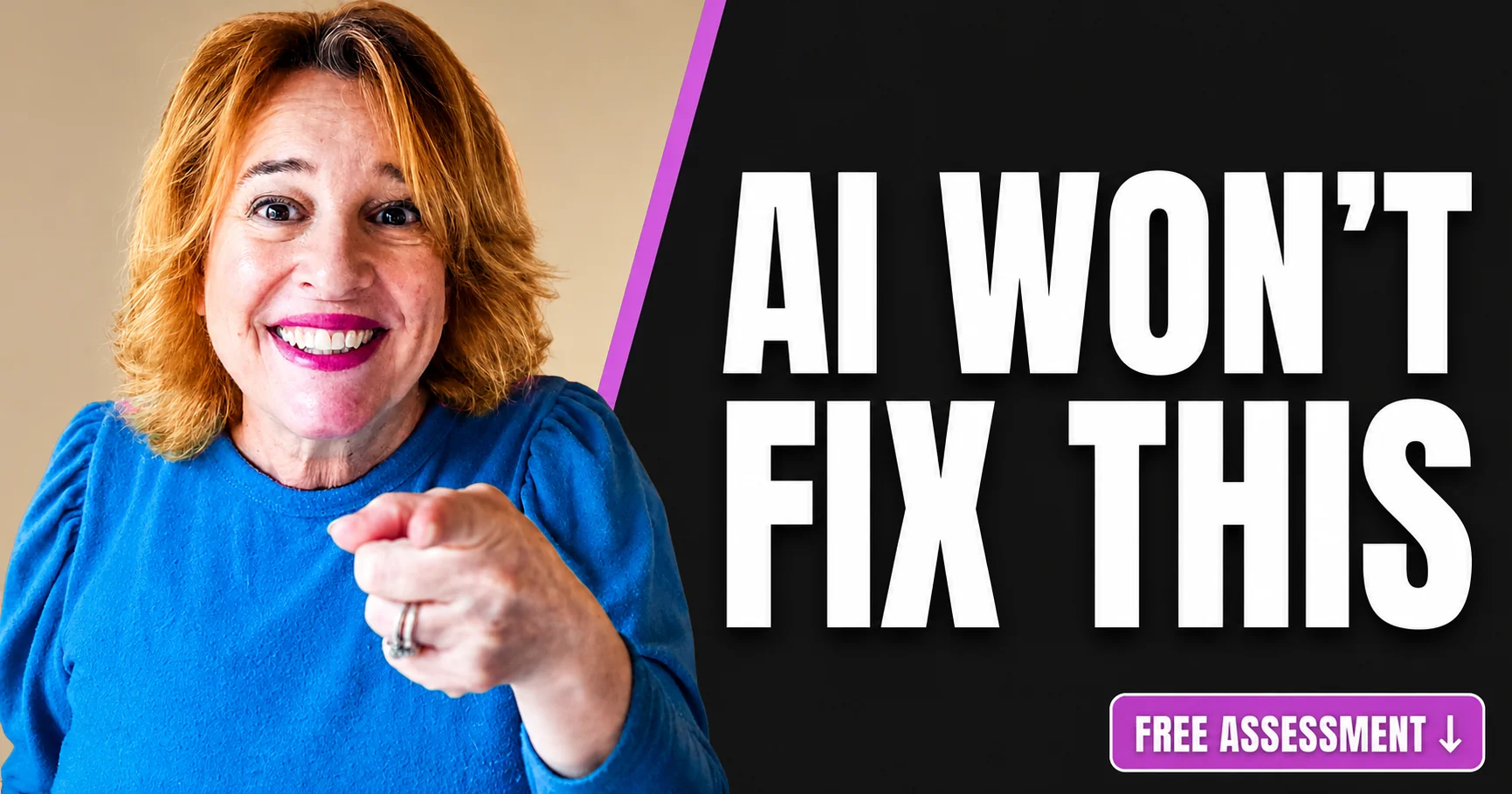
Not a reader? Watch the full breakdown here. ↑
Most established business owners — those generating $550K to $10M — didn’t get there by accident. They got there through intelligence, persistence, and a tolerance for chaos that would exhaust most people. That’s admirable. It is also exactly the problem.
The habits and instincts that built the business to its current size are almost always the same ones keeping it from scaling. Decisions still flow through you. Processes still live in your head. “Systems” still means you doing things consistently — not a structure that runs independently of you.
One of the most valuable principles we apply through the
is this:
The Map Is Not the Territory.
What that means in practice: the way you think your business runs and the way it actually runs are two very different things. You have a mental model of your operation — a map. But the territory (the real daily execution, the real decision flow, the real dependencies) often looks nothing like that map.
When growth is the plan — or when AI is the plan — and the map is wrong, you don’t accelerate to success. You accelerate to the discovery of every assumption you’ve been making about how your business actually functions.
Let’s be specific about this, because “operational maturity” can sound like consultant language for nothing in particular.
Here is what structural immaturity looks like inside a $1M–$5M business:
Decisions route back to you constantly.
Not because your team lacks capability — but because there are no defined decision rights. No one knows what they’re authorized to decide without your input. Everything from a client question to a vendor invoice becomes an escalation.
Processes exist — but only in practice, not in structure.
Things get done. Clients get served. Work gets delivered. But it happens because specific people — often you — carry institutional knowledge in their heads. If those people are unavailable, quality drops immediately. If they leave, the operation fractures.
Growth hiring doesn’t fix the core problem.
You add a team member. They need guidance. You provide it. Three months later, they’re still needing the same level of guidance — because you haven’t built a system, you’ve built a dependency. As one business growth analysis puts it,
Financial visibility is reactive, not proactive.
You know what happened last month. You’re not clear on what’s coming. You’re making decisions about growth based on revenue momentum, not on structural capacity.
Here is the AI-era truth most people aren’t saying out loud:
AI doesn’t solve problems. It amplifies whatever it touches.
Currently, 58% of small business owners use generative AI — up from 40% in 2024. But adoption without structural readiness is not a competitive advantage. It is a liability wearing the costume of innovation.
Consider what AI actually does in a structurally immature business:
AI accelerates output
— which means it accelerates the delivery of inconsistent, undocumented processes at scale.
AI automates workflows
— which means it automates the chaos and the workarounds your team has normalized.
AI surfaces your data
— which means it makes visible, in very clear terms, the gaps in how your operation is actually functioning.
According to research from WSI’s 2025 AI Business Insights Report, 81% of business leaders believe AI can help achieve their business goals — yet only 27% say AI is regularly discussed in company-wide strategic planning. That gap between belief and execution is a structural problem, not a technology problem.
As we’ve written previously on
why AI is exposing weak value propositions
: marketing amplifies what exists. AI exposes what doesn’t. Growth does the same. And right now, all three are happening simultaneously in most established businesses.
The owners who will win in this environment are not the ones who adopt AI the fastest. They are the ones who build the structural foundation that makes AI adoption genuinely productive — not just busy.
Revenue growth increases the volume of everything — client demands, team coordination, decision-making, financial complexity. If your business is structurally weak at $1M, it will not find stability at $2M. The problems will simply be louder and more expensive.
one financial analysis describes it
: when underlying operations are weak, adding more — more clients, more capital, more headcount — magnifies the problem instead of solving it. The business wasn’t working, so adding more to what’s not working doesn’t make it better.
That framing matters. It removes the comfortable illusion that scale is the strategy. Scale is the outcome of structural maturity — not the cause of it.
What to do instead:
Before the next growth initiative, audit your decision flow. Map where every significant decision currently lives. If more than 60% of critical decisions require owner input, you don’t have a team problem. You have a structural design problem.
The most structurally mature businesses on radstrategic.com’s
Structurally Mature Business Operations
framework share one trait: they installed structure before they automated. They designed decision rights, documented processes, and built accountability systems — and then applied AI as a multiplier on top of that foundation.
Businesses that skip this step don’t get the leverage. They get faster chaos.
The practical question is not “which AI tools should we use?” It is: “Is our operation designed to function without me? And if not, what is the structural gap that AI is about to amplify?”
What to do instead:
Before any AI implementation, run a structural readiness check. Can your team execute core workflows without your input? Are those workflows documented? Is there a decision rights framework in place? If the answer to any of those is no, start there.
This is where the principle becomes visceral: most business owners are managing based on how they believe the business works — not how it actually works. They have a mental map built during a simpler phase of the business. That map hasn’t been updated as complexity has grown.
This is not a failure of intelligence. It is a failure of structure. The business has outgrown the system that was adequate to run it.
The
begins with RADical Awareness precisely because of this. Before we redesign anything, we have to see reality clearly — not the story we’ve been telling about the business, but the actual operational reality. That is where every intelligent structural decision starts.
What to do instead:
Get outside of your own perspective. Take an honest inventory of what actually happens when you’re not available — not in theory, but in practice. Where do things break down? What doesn’t get decided? What escalates? That is your real structural map.
The conversation about AI in business has been dominated by fear of being left behind. Move fast. Adopt early. Automate everything.
That is the wrong frame for an established business owner.
The right frame: the businesses that will build durable competitive advantage in the AI era are the ones that are structurally ready to deploy it intelligently. They have documented processes. They have decision frameworks. They have teams that operate independently. They have the
that turns AI from a shiny object into a genuine force multiplier.
Everyone else will invest in AI and wonder why it didn’t change anything — or discover, at scale, the structural problems they’ve been papering over for years.
The question is not whether to use AI. The question is whether your business is structurally ready to use it well. And that question can only be answered by looking clearly at your actual operational reality — not your map.
The
Structural Independence Assessment™
is the place to start. In 10 minutes, you’ll get a clear score across four structural dimensions — and a precise picture of where your business is most vulnerable to the stress of growth and AI acceleration.
Because you cannot fix what you cannot see. And in this environment, the cost of not seeing clearly is getting higher every quarter.
Take the Structural Independence Assessment™ →
Revenue growth is a signal of market demand — not structural health. A business can grow revenue consistently while accumulating structural debt: owner dependency, undocumented processes, decision bottlenecks, and accountability gaps. That structural debt does not disappear with more revenue. It becomes more expensive and more visible.
Operational maturity is the degree to which your business can function — predictably, profitably, and independently — without requiring constant owner involvement in day-to-day decisions. It matters now because AI amplifies operational output. Businesses with mature operations see AI as leverage. Businesses with immature operations see AI accelerate existing dysfunction.
AI tools automate and accelerate whatever processes they are applied to. If those processes are undocumented, inconsistent, or owner-dependent, AI surfaces that clearly — through output inconsistency, automation failures, and team confusion about what the “right” workflow actually is. AI doesn’t hide structural problems. It illuminates them at scale.
Structural independence means your business has been designed to operate, decide, and deliver consistently — even when you’re not in the room. It means your team has clear decision rights, your processes are documented and repeatable, and your leadership model is built on accountability rather than proximity.
This is one of the eight operating principles of the RAD Business Success Method™. It means that your mental model of how your business works — your map — is almost always different from the operational reality. The longer you’ve been running the business, the more those two diverge. Acting on an outdated map without checking the territory is one of the most common causes of growth failure.
The simplest test: can your team execute your core workflows without your input, using documented processes, within a defined decision rights structure? If the answer is no — or “mostly” — your business is not structurally ready to leverage AI at scale. The
Structural Independence Assessment™
provides a precise diagnostic across four structural dimensions.
Hiring without structural design typically recreates the same problem with more people involved. If the business has no decision rights framework, no documented processes, and no accountability structure, new hires quickly require the same owner involvement as the people who came before them. Structural design must precede headcount growth.
Structure must come first. AI can be used to support documentation, surface workflow patterns, and create analytical visibility — but it cannot install the thinking clarity, decision frameworks, and leadership accountability that structural maturity requires. AI is a multiplier, not a builder.
Angie Dobransky is a strategic operating partner and the creator of the
. She helps established business owners transform owner-dependent companies into structured, scalable, self-sustaining businesses. Explore the
AI Essentials for Business Owners™ program
or take the
Structural Independence Assessment™
to see where your business stands.
structural independence assessment
Previous AI Will Expose Your Weak Decision Systems Faster Than Any Competitor
Next Why Scaling Without Structure Increases Stress (And How to Fix It)
Discover how to leverage your unique strengths to boost leadership and business success. Learn 3 actionable steps to focus on your strengths and avoid burnout.
Learn 3 powerful strategies to scale your business without adding hours to your workweek. Optimize pricing, streamline tasks, and leverage technology for sustainable growth
Unlock your reticular activating system (RAS) to sharpen focus, improve leadership, and achieve ambitious goals with neuroscience-backed strategies.
Discover why strategic rest boosts productivity more than hustle culture. Learn science-backed techniques to integrate intentional rest periods that fuel breakthrough thinking and better results.
Unlock RADical success with full-on participation. Learn how consistency, accountability, and lifelong learning lead to extraordinary results. Watch the video now!
Discover how thinking differently can unlock your potential and lead to RADical success. Learn mindset-shifting tips and take actionable steps for personal and professional growth today!
Weekly thinking on leadership, structure, and building a business that runs without you in the room
We won't send you spam. Unsubscribe at any time.
Find out where your business is still structurally dependent on you — in 10 minutes.
Take the Free Assessment →